GB 47372-2026: New Mandatory Safety Standard for Power Banks
China’s power bank industry is welcoming a critical regulatory upgrade.The existing recommended standard GB/T 35590-2017 will be replaced by GB 47372-2026, a new mandatory national safety standard.
The regulation shifts focus from basic performance requirements to intrinsic lithium battery safety, bringing stricter testing and design rules for all manufacturers.
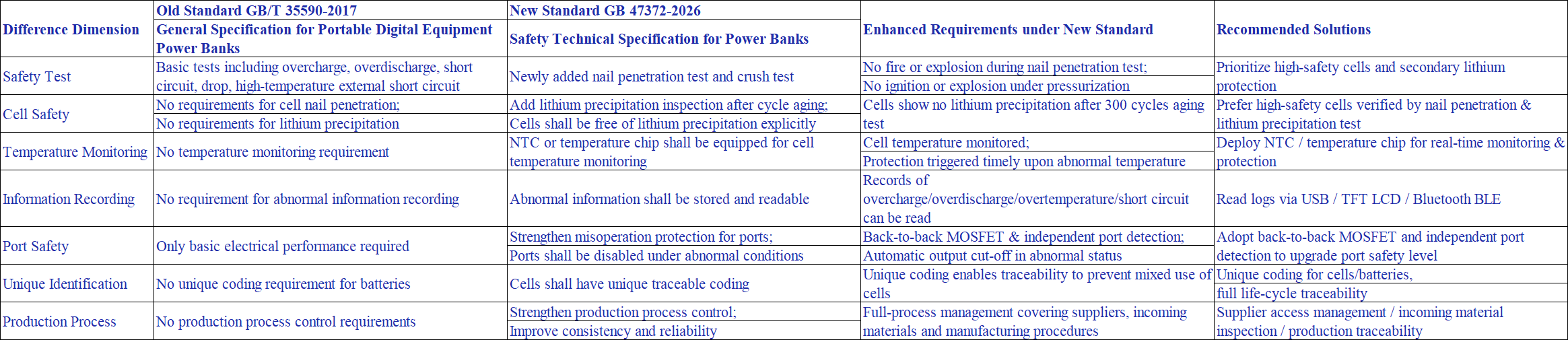
Core Changes at a Glance
✅ Stricter Safety Testing
New destructive tests are introduced: nail penetration test and crush test.
Devices must not catch fire or explode under these extreme conditions.Suggestion: Adopt high-safety cells plus secondary lithium protection circuits.
✅ Higher Cell Safety Benchmark
The new standard requires lithium precipitation inspection after 300 charge-discharge cycles. No lithium dendrite formation is permitted.
Suggestion: Source cells verified through nail penetration and lithium precipitation testing.
✅ Mandatory Temperature Monitoring
Temperature tracking (NTC or dedicated temperature IC) becomes compulsory. The system must trigger protection immediately once abnormal temperatures occur.
✅ Fault Data Logging
Power banks need to store readable logs for overcharge, overdischarge, overheating and short-circuit faults. Data can be accessed via USB, TFT screen or Bluetooth BLE.
✅ Enhanced Port Protection
Output ports must support automatic shutoff under abnormal status. Back-to-back MOSFETs and independent port detection are recommended to improve safety.
✅ Full Traceability for Cells
Every single cell must carry a unique traceable ID to prevent mixed usage of non-compliant cells, enabling full lifecycle management.
✅ Standardized Production Control
Enterprises must reinforce whole-process management covering supplier auditing, incoming material inspection and production tracking to guarantee consistent quality.
Systematic Compliance Design Roadmap
Battery Cell → AFE/BMS Secondary Protection → Intelligent Main Controller → Back-to-back MOS & Independent Port Detection → Traceable Production System
What This Means for Manufacturers & Brands
The transition from a voluntary specification to mandatory safety rules raises industry entry barriers. Low-end products with simplified protection designs will face elimination.
IKOE offers professional engineering consultation to help partners develop fully compliant power bank solutions.Get in touch with our technical team for custom support.